Blog
September 1, 2026
In many cases, the CRM has become the center of the universe for Advancement technology. It handles relationships, gifts, campaigns, portfolios, and fundraising processes. But as institutions evolve and move toward more sophisticated tech, a critical question is emerging:
Does the CRM need to take care of becoming the data warehouse, historical archive, analytics tool, and basis for AI?
At Attain Partners, we believe the answer is no. The next step in the evolution of the Advancement tech stack involves creating a dedicated data and intelligence layer. This layer unites all of an institution’s data, preserves its history, runs analytics, and paves the way for predictive and AI-driven technologies. We call this the Advancement Data Warehouse.
An Advancement CRM stores some of an institution’s most precious relationship data, but certainly not all of it. It might show that a constituent was a student and is now an alumnus, that they attended events, bought athletics tickets, or participated in digital campaigns. But these interactions often happen across many different systems. The CRM knows they donated $10,000 last year, but the student system knows their academic history, the event system knows they attended three alumni gatherings, the marketing system tracks their engagement, and Athletics knows they are a season-ticket holder. A wealth provider might even signal their high giving capacity. Each piece of data is helpful on its own, but together, they tell the full story of the constituent.
The problem is that most institutions lack a single platform where this story is told. This is where the Advancement Data Warehouse comes in. Instead of forcing every bit of institutional data into the CRM, an institution can build a dedicated analytical environment underneath it. In this setup, the CRM remains the system for engagement, while the Advancement Data Warehouse becomes the system of intelligence.
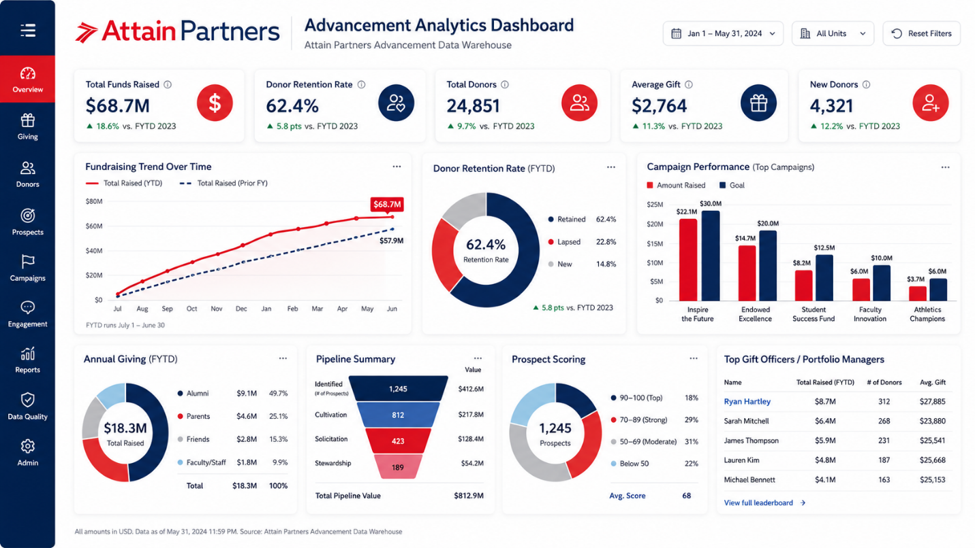
The Attain Partners Advancement Data Warehouse is built on the idea that data becomes more meaningful, credible, and actionable as it moves through the platform.
The Bronze layer collects and preserves source-system data in its original or near-original form, creating a complete historical foundation for downstream processing. Sources may include CRM extracts, gifts and transactions, constituent records, engagement activity, campaigns, financial data, and third-party enrichment.
In the Silver layer, raw data is standardized, reconciled, validated, and connected across systems. This is where the institution establishes trusted definitions, resolves constituent identities, links households and organizations, standardizes giving histories, and aligns campaign and fund hierarchies. The result is a connected Constituent 360 view that reflects the institution’s full relationship with each individual.
The Gold layer structures trusted data around the questions Advancement leaders, fundraisers, and analysts need to answer. It supports fundraising and campaign performance, pipeline analysis, annual giving, donor retention, prospect and engagement scoring, and financial reconciliation.
These datasets can feed Power BI, Tableau, Salesforce, CRM Analytics, predictive models, and AI agents. The progression creates a clear distinction between the data source systems provide, the information the institution trusts, and the intelligence Advancement uses.
Think about a development officer preparing for a meeting with an alumnus. Today, they likely have to jump between several sources, like the CRM, a reporting dashboard, and an events system, just to get the full picture. Now, imagine a different scenario: the officer opens a profile and sees the whole story at once. They see the alumnus has been giving for twelve years, attended three events in the last eighteen months, and has a growing estimated capacity. They can see that while the alumnus is in a major gift portfolio, there hasn’t been any contact in six months.
That isn’t just a CRM record; that is Constituent Intelligence. You don’t get this by just adding more fields to Salesforce. You get it by integrating data beneath the CRM and bringing that information to where people actually work. A true Constituent 360 should reflect the entire relationship, not just the data trapped in one app.
For many years, Advancement analytics has been all about answering retrospective questions:
But they are still key questions. What Advancement can do with a modern data platform is move far beyond that. Once giving, engagement, prospect, campaign, financial, and constituent data are connected, Advancement can start understanding not only what happened, but why. Advancement leaders can start analyzing why donor retention dropped in a certain population, what campaigns lead to building more robust relationships, whether there is anything that could improve gift officer portfolios, and which engagement activities are associated with future giving.
On the same basis, Advancement could conduct predictive analytics. Not just to look at what happened historically, but see which donors are most likely to renew, who among the annual giving donors are potential major givers, who among prospects is showing signs of disengagement, and who is most likely to respond to a certain campaign or event. At some point, this approach would lead to prescriptive intelligence. No longer will Advancement provide yet another dashboard for someone to analyze; it would be able to answer much more practical questions: who should I call today and why? This is the difference between reporting and an intelligence platform.
AI will take this to a whole new level. One day, a fundraiser might start their morning by asking, “Which prospects should I prioritize this week?” An AI assistant could look at engagement, giving patterns, and even digital interactions to suggest a list. Before a meeting, they could ask for a briefing and get a concise report on trends, interests, and history.
However, the quality of an AI assistant depends entirely on what is happening underneath. An AI can give fast answers, but if the data is inconsistent, full of duplicates, or poorly governed, those answers will be wrong. The Advancement Data Warehouse is essentially an institution’s AI readiness strategy. You can’t have reliable AI without reliable data.
The idea is not to add one more system for Advancement professionals to go and look for information in it. Advancement Data Warehouse is supposed to stay mostly invisible and power all the existing applications. A development officer can keep using mostly Salesforce. Advancement leadership could keep consuming Power BI or Tableau dashboards. Data analysts would work with curated datasets. Data scientists would use the same data to build predictive models. Future AI agents would consume governed Advancement information and return recommendations directly into the workflow of frontline users. All of these different user experiences could be powered by the same data foundation.
This common framework is able to resolve another challenge that Advancement teams commonly encounter in their reporting practice: the lack of consistency between different systems and teams interpreting the same metric differently. Instead of having every dashboard, every spreadsheet, and every analyst come up with their own unique interpretation of what is meant by “donor retention,” “lifetime giving,” “campaign performance,” “pipeline,” or “engagement,” it is possible to build the definition of these metrics only once in a governed data product and reuse them consistently throughout the organization. In case the Vice President for Advancement asks a question, the same definition of the data should be used in CRM, executive dashboards, analyst reports, and even an AI assistant.
The potential only grows once the Advancement Data Warehouse is aligned with a university’s overall enterprise data strategy. The constituent lifecycle does not start from the very first gift. Quite often, it starts years ago when someone became a student and continues progressing from Student > Alumnus > Engaged Constituent > Donor > Advocate. Yet, these stages tend to span organizational and technological boundaries. Information about being a student belongs to Academic Affairs or the Registrar’s domain. Financial information is part of the ERP. Athletic engagement data resides within the Athletics domain. Digital interaction information is stored in Marketing. Only Advancement knows the information about fundraising relationships.
Modern university data architecture gives the ability to keep these domains governed by the corresponding parts of the organization while making available the appropriate information in places where it adds value. Advancement does not need to own the Student data domain to know that someone earned two degrees at the institution. It does not need to own the Athletic data domain to understand that someone was a season-ticket holder for 15 years. It does not need to own the Finance data domain to reconcile philanthropic activities with the general ledger. Advancement Data Warehouse becomes the place where this information can be combined responsibly and turned into actionable intelligence without violating ownership, governance, and security policies.
At Attain Partners, we see the Advancement Data Warehouse as more than just a technical implementation. It is the foundation for a total transformation in how Advancement uses information. We start by focusing on business questions:
By focusing on these questions, we ensure the warehouse is designed to meet actual goals rather than just copying tables from a source system.
From there, the institution can design a data model, connect the right systems, and build the Bronze, Silver, and Gold layers. The technology used can vary, whether it’s Databricks, Snowflake, or Microsoft Fabric. The specific tools are important, but they shouldn’t be the starting point. The architecture should follow the university’s strategy, not the other way around.

Ryan Hartley is a Managing Director at Attain Partners, where he leads Data Services within the Attain Digital practice, delivering innovative and scalable solutions to help clients unlock the full potential of their data for operational excellence and strategic growth. With over 15 years of experience in data integration, master data management (MDM), data quality, governance, and advisory services, Ryan has a proven track record of transforming data into a strategic asset across diverse industries, including higher education, nonprofit, healthcare, retail, and manufacturing. Prior to joining Attain Partners, he held leadership roles overseeing large-scale technology initiatives focused on customer relationship management (CRM), MDM, and data governance. Ryan is known for his innovative approach, collaborative leadership, and ability to align technology strategies with business objectives to deliver measurable results.

Keep Your Finger
on the Pulse!
Subscribe to our monthly email newsletter for expert content to solve your organization’s issues and advance your mission.
Keep Your Finger
on the Pulse!
Subscribe to our monthly email newsletter for expert content to solve your organization’s issues and advance your mission.