• About
    • The Attain Way
    • Leadership
    • Who We Serve
    • Alliance Partners
    • Contract Vehicles
    • Attain Digital
      • Executive in Residence Program
    • Attain Research
      • Indirect Cost Rate Policy Updates and Guidance
      • Uniform Guidance
  • Services
      • Services
      • Technology
        • Advanced Analytics
        • Application Development and Modernization
        • Data Science
        • Emerging Technology
        • Enterprise Business Solutions
        • Salesforce Innovation
          • Attain Accelerate
          • Managed Services for CRM
          • Salesforce Digital Engagement
      • Strategy
        • Advancement Advisory
        • Attain Talent Recruiting Services
        • Business Process Modernization
        • Change Management
        • Enrollment Management and Student Services
        • Fundraising Advisory and Precision Philanthropy
        • Inclusion, Diversity, Equity, and Allyship (IDEA) Transformation Services
        • Juran, an Attain Partners Company
        • Library Planning and Strategy
        • Organizational Transformation
        • Program and Project Management
        • Shared and Managed Services
        • Strategic Finance
        • Strategic Planning
      • Compliance
        • Asset Management and Valuation
        • Contract Negotiation
        • Cost Recovery Optimization
        • Embedded Talent
        • Financial Aid
        • Grants Management
  • Products
    • Rate
    • Research Performance
    • Strategic Finance Performance
  • Newsroom
    • Blog
    • Events & Webinars
    • News
    • Insights
    • Awards
    • Case Studies
  • Careers
    • Open Roles
  • Contact
    • Subscribe
  • Linkedin
  • Twitter
  • Facebook
  • About
    • The Attain Way
    • Leadership
    • Who We Serve
    • Alliance Partners
    • Contract Vehicles
    • Attain Digital
      • Executive in Residence Program
    • Attain Research
      • Indirect Cost Rate Policy Updates and Guidance
      • Uniform Guidance
  • Services
      • Services
      • Technology
        • Advanced Analytics
        • Application Development and Modernization
        • Data Science
        • Emerging Technology
        • Enterprise Business Solutions
        • Salesforce Innovation
          • Attain Accelerate
          • Managed Services for CRM
          • Salesforce Digital Engagement
      • Strategy
        • Advancement Advisory
        • Attain Talent Recruiting Services
        • Business Process Modernization
        • Change Management
        • Enrollment Management and Student Services
        • Fundraising Advisory and Precision Philanthropy
        • Inclusion, Diversity, Equity, and Allyship (IDEA) Transformation Services
        • Juran, an Attain Partners Company
        • Library Planning and Strategy
        • Organizational Transformation
        • Program and Project Management
        • Shared and Managed Services
        • Strategic Finance
        • Strategic Planning
      • Compliance
        • Asset Management and Valuation
        • Contract Negotiation
        • Cost Recovery Optimization
        • Embedded Talent
        • Financial Aid
        • Grants Management
  • Products
    • Rate
    • Research Performance
    • Strategic Finance Performance
  • Newsroom
    • Blog
    • Events & Webinars
    • News
    • Insights
    • Awards
    • Case Studies
  • Careers
    • Open Roles
  • Contact
    • Subscribe
  • Linkedin
  • Twitter
  • Facebook
Home » Newsroom » Blog
Blog
January 28, 2026

Modern Research Libraries Need More Than a Simple FTE Calculation

Higher EducationLibrary ServicesResearchThought LeadershipUniform Guidance

By Hilary Craiglow and Mike Leonard, Attain Partners

For decades, the library component of institutional indirect cost rates has been treated as a relatively straightforward calculation; a two-step FTE and Salary and Wage (S&W) allocation of the library operational costs combined with cross allocations for general administration and library space-related costs based on square footage. This approach, while compliant with federal policyand cost accounting standards, may underestimate the actual costs libraries incur in supporting the modern research enterprise.

Despite heightened attention to indirect cost policy over the past year, to date, no federal caps or policy changes have been implemented. Institutions can rely on current rules while preparing for possible future shifts. As universities continue operating under existing guidance, a Library Cost Study is an important part of the process.

How Universities Develop the Library Component

Under the standard indirect cost rate structure outlined in Uniform Guidance (2 CFR 200), most institutions allocate library costs using the Modified Total Direct Cost (MTDC) base methodology with facility space as a primary factor in the allocation of costs.

Developing the library component:

  • Library operations costs (staffing, collections, technology) are typically combined with the institution’s facility and administrative cross-allocations.
  • The total library cost pool is then allocated to organized research by utilizing an FTE methodology, considering a ratio of university classifications of students, professional staff, graduate students, faculty, and other users.
  • The library costs allocated to professional staff and faculty are further allocated by salaries & wages of the major university functions, including organized research.

The resulting library component appears in the Library line of the institution’s F&A rate proposal, typically accounting for 1-3 points of the total F&A rate.

What This Traditional Framework Captures and What It Doesn’t

These standard allocation methodologies were developed when libraries were primarily physical repositories. They effectively capture:

  • Building costs, including utilities, maintenance, and depreciation
  • Basic facility operational staffing (e.g., circulation and reference desks)
  • Print collections acquisition and processing
  • General library administration

The FTE standard methodology was not designed to capture the specialized research support services provided by libraries that have emerged over the past two decades. Examples of library support for the research enterprise all along the phases of the research lifecycle:

  • Research Phase: Plan and Design
    • Evidence synthesis and systematic reviews
    • Institutional subscriptions to digital information resources 
  • Research Phase: Collect and Create
    • Institutional data repositories and storage systems
    • Data management planning
  • Research Phase: Analyze and Collaborate
    • Data curation and metadata services
    • Persistent identifier management
  • Research Phase: Share and Disseminate
    • Publishing services infrastructure
    • Institution-wide open access publishing agreements
  • Research Phase: Manage and Store
    • Data security services
    • Research data preservation services

These modern library materials and services entail significant personnel costs, technology infrastructure investments, and ongoing operational expenses that are largely unrelated to an institution’s square footage or the makeup of students, faculty, and staff.

The potential shortfall in recovery of modern library costs becomes even more prevalent for universities with a high student population. Public universities and non-medical universities often have very large student populations, and that results in a disproportionate amount of library costs being allocated to the instruction function, leaving a small amount of costs to be allocated to organized research, which falls significantly below the specialized research support costs provided by libraries.

The Library Cost Study Alternative

Uniform Guidance explicitly recognizes that standard allocation methods may not adequately reflect actual resource costs. Appendix III to Part 200 of 2 CFR, A.2.d.(3) states:

If the expenses in a cost grouping are more general in nature, the distribution may be based on a cost analysis study which results in an equitable distribution of the costs. Such cost analysis studies may take into consideration weighting factors, population, or space occupied if appropriate.

What the Study Involves

A library cost study is a special study. It is a federally accepted cost accounting methodology to develop a more accurate distribution of library support costs.

The Study involves:
  • Collaborative Foundation
    • Study conducted jointly by Attain Partners and the university library, using institutional documents and direct input from library personnel.
  • Planning and Setup
    • Develop a detailed project plan and timeline.
    • Identify project team, conduct an on-site visit to prepare for data collection.
    • Develop in-person and virtual surveys.
  • Data Collection
    • Gather materials, financial data, expenditures, facility information.
    • Conduct recurring in-person and virtual purpose of library use surveys.
    • Complete a space use inventory.
  • Costing & Analysis
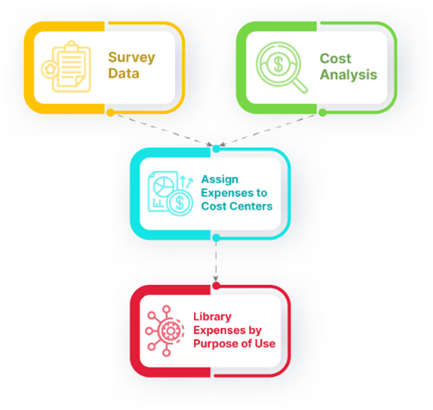
    • Analyze survey results, expenditures, space usage, and resource data in accordance with Uniform Administrative Guidance.
    • Assign library activities to federally defined cost centers (e.g., organized research, instruction, patient care, other sponsored activities, other institutional activities).
    • Allocate library expenses and cross-allocations to the appropriate cost centers.
  • Reporting & Results
    • Produce a final report identifying the allowable Facilities & Administrative (F&A) library expense percentage attributable to organized research.
Diagram showing the steps of a library cost study process: Survey Data and Cost Analysis feeding into Assign Expenses to Cost Centers, resulting in Library Expenses by Purpose of Use.

Implementation Considerations

Institutions considering a library cost study should be aware of several factors:

Timing

A statistically sound cost study requires a year of periodic data collection, and, typically, three months to set-up and should be timed in conjunction with the next F&A rate proposal cycle.

Documentation Requirements

The study must meet federal cost accounting standards and withstand audit scrutiny. This requires rigorous methodology and comprehensive documentation.

Institutional Impact

Results may reveal that library research support costs are significantly higher than currently recovered, requiring institutional decisions on cost-recovery strategies.

The Path Forward

For research universities, the question is not whether libraries incur high costs in support of sponsored research; they clearly do. The question is whether institutions accurately capture and recover those costs.

Standard FTE allocation methodologies remain compliant with federal regulations and may be appropriate for institutions where local investments in libraries have not allowed significant evolution beyond traditional models. However, for institutions with high student populations or where libraries provide substantial research information services, significant investments in journal and data licensing, data management/curation services, compliance support for data plans and open publishing, and specialized research consultation, a library cost study offers a more accurate and defensible approach. Should federal research funding policies continue to evolve, institutions need reliable data about their research support costs. Recently, the FAIR model introduced by the JAG includes a separate allocation and charge to awards for these research support costs provided by libraries. For many universities, the library component of their F&A rate may be one of the least examined, and potentially most underestimated, elements of their cost structure. Additional context on indirect costs is available in our report, Indirect Cost Rates and Recovery, commissioned by Association of American Universities (AAU) and the Council on Governmental Relations (COGR).

A library cost study isn’t just an accounting exercise. It’s a strategic investment in understanding the true cost of supporting the research enterprise.

Attain Partners – Cost Study Experts

Leveraging our deep understanding of university and library structures, our team works to strengthen your library system by providing custom library strategy, operations, and technology expertise with innovative recommendations based on trusted best practices.

Interested in learning more about library cost studies and how they can support your institution’s research mission? Contact us today.

About the Authors

Hilary Craiglow is a Senior Manager at Attain Partners, leading our team of library strategists to strengthen library systems. With extensive experience leading academic and research libraries, Hilary has a deep understanding of college and university systems. She is a strategic and visionary administrator, melding rich library traditions with innovative forward-thinking services. As a data and mission-driven leader, she employs proven evaluation and assessment methods and creates organizational transformation through empathy and partnership. Hilary helps library leaders achieve their mission faster, more efficiently, and with greater impact.

Michael Leonard is a Senior Grants Management Consultant at Attain Partners. Prior to joining the firm in July 2025, he had over 33 years of progressive federal financial management experience within the Department of Health & Human Services as a College & University National Specialist and Supervisory Accountant. Being nationally recognized as an expert in college and university cost allocation, with extensive leadership in high-stakes negotiations, regulatory compliance, and inter-agency coordination, he demonstrated the ability to drive significant cost savings, lead cross-functional teams, and provide national-level guidance and training on cost principles under 2 CFR Part 200. He has a proven track record in managing field office operations, mentoring staff, and representing federal interests in detailed presentations and Q&A at national and virtual conferences.

Michael brings deep expertise in federal financial management and cost allocation. Before joining the firm in July 2025, Michael spent over 33 years at the U.S. Department of Health & Human Services, where he served as both a College & University National Specialist and Supervisory Accountant.

Nationally recognized for his leadership in college and university cost allocation, Michael has led high-stakes negotiations, driven regulatory compliance, and facilitated inter-agency coordination across complex federal landscapes. His work under 2 CFR Part 200 has shaped national guidance and training efforts, helping institutions navigate cost principles with confidence and precision.

Michael’s proven ability to lead cross-functional teams, mentor staff, and manage field office operations has consistently delivered measurable cost savings and strategic outcomes. He is a sought-after speaker and federal representative, known for his engaging presentations and insightful Q&A sessions at both national and virtual conferences.

Prev Post
Related Content
January 28, 2026
The Key to Building Successful Project Teams
Read more
January 27, 2026
The Human Side of Advancement: A Conversation with Trishana E. Bowden and Reshma Patel-Jackson
Read more
January 23, 2026
Introducing Attain Partners' AI-Driven Source-to-Target Mapping Accelerator
Read more

Subscribe to Our Newsletter

  • This field is for validation purposes and should be left unchanged.
  • This field is hidden when viewing the form
  • About
    • The Attain Way
    • Leadership
    • Who We Serve
    • Alliance Partners
    • Contract Vehicles
    • Attain Digital
      • Executive in Residence Program
    • Attain Research
      • Indirect Cost Rate Policy Updates and Guidance
      • Uniform Guidance
  • Services
    • -
      • Services
    • -
      • Technology
        • Advanced Analytics
        • Application Development and Modernization
        • Data Science
        • Emerging Technology
        • Enterprise Business Solutions
        • Salesforce Innovation
          • Attain Accelerate
          • Managed Services for CRM
          • Salesforce Digital Engagement
    • -
      • Strategy
        • Advancement Advisory
        • Attain Talent Recruiting Services
        • Business Process Modernization
        • Change Management
        • Enrollment Management and Student Services
        • Fundraising Advisory and Precision Philanthropy
        • Inclusion, Diversity, Equity, and Allyship (IDEA) Transformation Services
        • Juran, an Attain Partners Company
        • Library Planning and Strategy
        • Organizational Transformation
        • Program and Project Management
        • Shared and Managed Services
        • Strategic Finance
        • Strategic Planning
    • -
      • Compliance
        • Asset Management and Valuation
        • Contract Negotiation
        • Cost Recovery Optimization
        • Embedded Talent
        • Financial Aid
        • Grants Management
  • Products
    • Rate
    • Research Performance
    • Strategic Finance Performance
  • Newsroom
    • Blog
    • Events & Webinars
    • News
    • Insights
    • Awards
    • Case Studies
  • Careers
    • Open Roles
  • Contact
    • Subscribe

© Copyright 2026 Attain Partners

Terms of Use | Privacy Policy | Sitemap

LinkedIn logo in yellow circle
Twitter logo in cyan blue square
Facebook logo in navy blue triangle

Attain Partners
1650 Tysons Boulevard
Suite 1530
McLean, VA 22102

Phone: 703.857.2200
Email: [email protected]

Salesforce Consulting Partner logo
Salesforce Consulting Partner of the Year Education seal
Salesforce Equality Partner badge
Salesforce Summit Partner badge

Scroll to top

Keep Your Finger on the Pulse!

Keep Your Finger
on the Pulse!

Subscribe to our monthly email newsletter for expert content to solve your organization’s issues and advance your mission.

Keep Your Finger on the Pulse!

Keep Your Finger
on the Pulse!

Subscribe to our monthly email newsletter for expert content to solve your organization’s issues and advance your mission.