Blog
August 24, 2026
In the first post in this series, we introduced the Student Digital Experience, or SDX, Maturity Model as a way for campus leaders to describe where their digital services are today, where they need to go, and which capabilities must be built in sequence. The model looks beyond any single portal, app, chatbot, or system. It treats student digital experience as an institutional capability shaped by governance, data, process design, accessibility, support operations, measurement, and responsible use of AI.
Part of the SDX Maturity Model Series
This blog builds on Why Higher Education Needs a Student Digital Experience Maturity Model, which introduces the five levels of SDX maturity and the institutional capabilities that support effective student experiences.
The SDX Maturity Model includes five levels: Foundational, Connected, Personalized, Predictive, and Orchestrated.
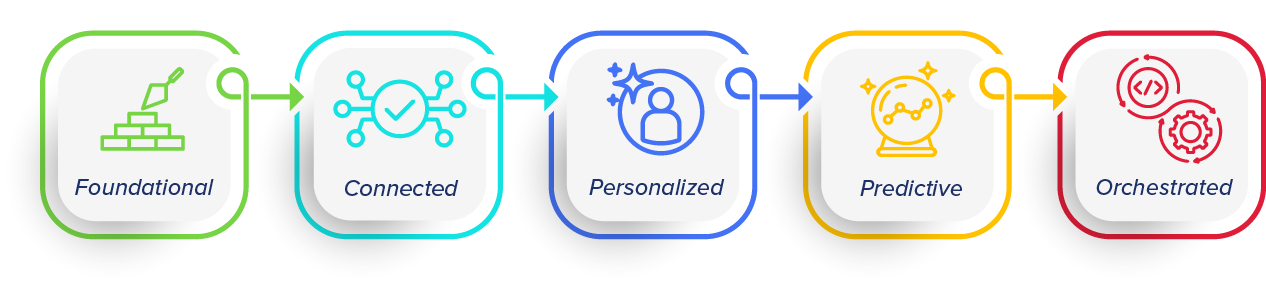
The Student Digital Experience (SDX) Maturity Model
In this blog, we’ll focus on the first three: Foundational, Connected, and Personalized.
These are the core stages, where institutions move from basic digital availability to experiences that are easier to navigate, more coherent across systems, and more relevant to each student’s context. They are also where many campuses can create the most immediate improvement.
Students notice when they can find what they need, avoid repeated logins, understand instructions, and clearly see what happens next. These basics create trust. Without them, advanced capabilities such as predictive outreach or AI-supported guidance rest on an unstable foundation.
What Students Experience
At the Foundational level, core digital services exist, but they are fragmented. The student information system, learning management system, financial aid forms, advising tools, portal pages, support inboxes, and knowledge articles may all be available, yet operate as separate pieces. Institutions at this stage focus on reliability, minimum usability, and basic access coverage.
For students, the experience can feel clunky and inconsistent. They may sign in to multiple systems, search office-centered websites, interpret different labels, or submit forms without meaningful confirmation. A student may see a registration hold but not understand the cause, owner, or next step. Another may upload a financial aid document and receive no clear status update.
Foundational maturity is not glamorous, but it is essential; it establishes the essential capabilities that support every subsequent stage. Institutions should identify the most important student-facing services, clarify ownership, and establish baseline standards for usability, accessibility, security, privacy, and support. Expanding single sign-on, improving mobile usability, simplifying navigation, applying plain language, and making forms accessible can have immediate impact.
As a core requirement, accessibility should be established at the Foundational level. Students use different devices, assistive technologies, languages, and levels of digital fluency. Clear labels, consistent structures, captions, transcripts, keyboard navigation, meaningful error messages, and plain-language instructions are core elements of equity.
Basic governance also starts here. Some systems may use single sign-on while others do not. Some tools receive privacy or accessibility review while others are adopted locally. AI experimentation may occur in isolated pilots. The goal is to set minimum expectations so the institution can scale safely.
Measurement at this level often includes uptime, ticket volume, call volume, and page views. Those are useful starting points, but institutions should also ask experience questions:
Once the basics are reliable, institutions can connect systems and service touchpoints. At the Connected level, the goal is to reduce friction by eliminating dead ends, improving handoffs, expanding single sign-on, enabling targeted data sharing, and providing consistent confirmations and case status.
Connected maturity requires institutions to integrate digital services across systems and workflows. A form may be online but disconnected from the portal. A reminder email may link to a general landing page instead of the exact workflow. A student may complete one step but still have to notify another office. These gaps make the experience feel fragmented even when each system works.
A connected student experience gives students clearer pathways. Instead of searching by office name, students can find services organized around tasks such as registering for classes, paying a bill, submitting financial aid documents, requesting advising, or resolving a hold. Status visibility is one of the clearest signs of this level. Students should see whether a request was submitted, received, under review, awaiting action, approved, or completed.
| Submitted → | Received → | Under review → | Awaiting action → | Approved → | Completed |
Support begins to function as a coordinated digital front door. Shared intake forms, case identifiers, predictable routing, and escalation paths help students get to the right place faster. Staff can see what has already happened and avoid asking students to repeat context. Cross-office handoffs become more visible and accountable.
Data maturity at this level is selective and practical. Institutions can prioritize the data integrations that matter most for high-priority student journeys. They should focus on data flows that matter most for priority journeys. For example, an onboarding checklist may need to show orientation, immunization, advising, housing, financial aid, and transcript status.
Business process alignment is critical. Effective integration depends on well-designed business processes. If responsibilities are unclear, requirements are duplicative, or manual handoffs remain hidden, connecting systems may simply move confusion faster. Institutions should map priority journeys from the student perspective and identify where office-specific processes create friction.
Integration depends on process design. Map priority journeys from the student perspective, clarify responsibilities, remove duplicate requirements, and make handoffs visible.
The Personalized level builds on connection by making the experience more relevant to each student. Digital services begin adapting to context such as program, modality, progression, holds, financial aid status, communication preferences, and current tasks. The goal is to reduce cognitive load so students do not sort through generic information to determine what applies to them.
Effective personalization uses governed student data to provide relevant guidance based on each student’s context. A newly admitted first-year student, an online graduate student, a transfer student, a returning adult learner, and an international student should not all see the same checklist if their requirements differ.
Personalized SDX shows up in practical ways. Smart forms prefill known information, ask only for what is missing, support save-and-resume, and provide clear error messages. Financial aid checklists adjust based on what the student needs to submit. Degree planning tools highlight remaining requirements and flag prerequisite gaps. Help content appears inside the workflow where the student needs it.
Personalization in Practice
Support becomes more contextual as well. When a student contacts an advisor or service representative, the staff member can see relevant status and recent activity, subject to appropriate access controls. Students no longer need to reconstruct their situation every time they ask for help, and staff can provide faster, more accurate guidance.
Personalization depends on trust. Institutions must define what data may be used, for what purpose, who can access it, how it is maintained, and how students are informed. Personalization should be transparent, purposeful, respectful, and clearly connected to student needs.
Governance Questions for Personalization
Communication governance is especially important. Personalized messaging can become overwhelming if every office sends targeted reminders independently. Students may receive too many messages, conflicting instructions, or inconsistent deadlines. Institutions should establish channel preferences, cadence limits, message ownership, and escalation rules.
AI may begin to support personalization through smart search, summarization, guided responses, content recommendations, workflow assistance, or staff-facing next-step suggestions. But AI should be introduced within clear boundaries. Sensitive decisions should remain subject to human review. AI-generated guidance should be monitored for accuracy, accessibility, privacy, and equity.
Across the first three levels, the institution moves from fragmented availability to integrated relevance. Foundational maturity makes the basics reliable and accessible. Connected maturity reduces friction across systems and handoffs. Personalized maturity uses governed context to make guidance easier to act on.

Foundational
Reliable, accessible digital services

Connected
Coordinated systems, processes, and handoffs

Personalized
Relevant guidance based on governed student context
These levels are not merely technical milestones. They require shared standards, cross-functional ownership, content governance, journey mapping, data stewardship, accessibility practices, and measurement routines. They also prepare the institution for Predictive and Orchestrated maturity, where signals support proactive, institution-wide experience management.
Attain Partners helps higher education institutions strengthen the systems, processes, governance, and operating models that shape the student digital experience. Explore the Student Digital Experience Maturity Model and learn how institutions can build the capabilities needed to advance their SDX maturity.

John Knost is a seasoned leader with over 25 years of experience in higher education student operations, compliance, and technology transformation. He has successfully held leadership positions in large-scale ERP and CRM implementations, including Workday and Salesforce, across multi-campus systems. John holds a Master of Science in Higher Education Administration and a Graduate Certificate in Enrollment Management from the University of Miami.

Keep Your Finger
on the Pulse!
Subscribe to our monthly email newsletter for expert content to solve your organization’s issues and advance your mission.
Keep Your Finger
on the Pulse!
Subscribe to our monthly email newsletter for expert content to solve your organization’s issues and advance your mission.