Blog
October 6, 2026

How do higher education leaders make technology investments that address today’s pressures while preparing their institutions for the future?
On September 29, Attain Partners brought together higher education CIOs and senior technology leaders in Denver for Built to Last: Looking Back to Lead Forward, our pre-EDUCAUSE executive dinner. Through an interactive case discussion, participants shared experiences, challenged assumptions, and explored the decisions shaping their institutions.
The evening centered on Summit University, a fictional institution facing declining traditional enrollment, fragmented systems, limited workforce capacity, and competing expectations for innovation. With a one-time $6 million transformation fund, participants were asked to choose two investment priorities and explicitly defer others.
As the conversation progressed, new developments tested those choices: an urgent email about an AI assistant providing inaccurate financial aid guidance and a voicemail introducing a potential philanthropic investment with significant conditions.
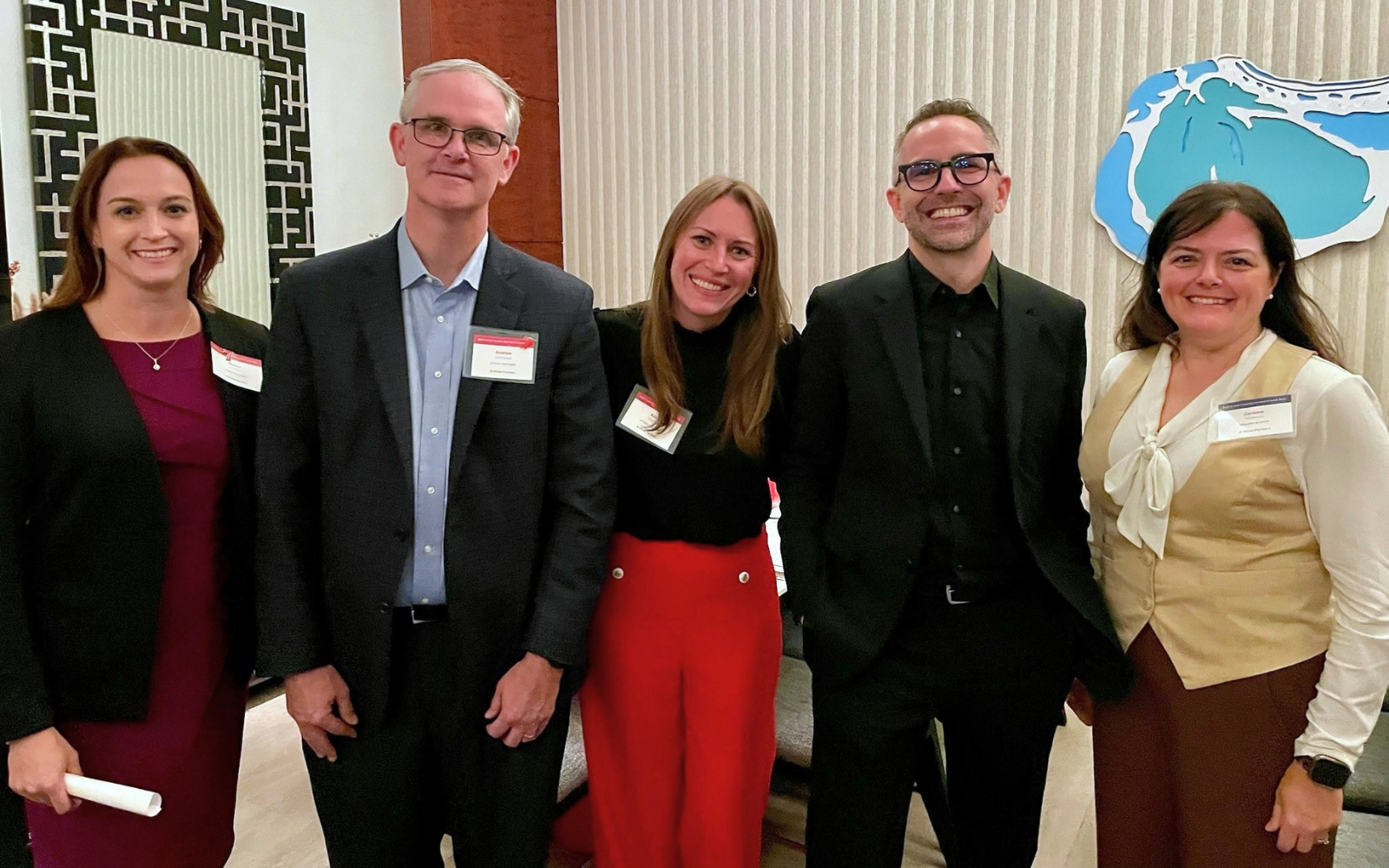



The case was fictional, but the tradeoffs sparked a candid discussion grounded in participants’ own experiences. Several clear themes emerged.
Across the tables, leaders returned to the same starting point: meaningful progress depends on reliable, connected data.
Whether the goal was improving student engagement, strengthening enrollment, or introducing AI, participants emphasized the need for a stronger data foundation. Yet when attendees were asked how many felt their own institutions already had that foundation, very few hands went up.
That moment captured one of the evening’s most important tensions. Leaders recognize the importance of data, but building the governance, quality, and integration needed to use it effectively remains difficult to establish.
The discussion also moved beyond infrastructure to how institutions act on what they know. Are insights informing outreach to prospective students? Are technology and marketing leaders working together to understand which audiences to engage and how? Can schools and programs learn from one another when their information lives in separate systems?
A stronger data foundation helps institutions make coordinated decisions about the people they serve and the experiences they deliver.
Participants saw AI as an important part of institutional relevance and student preparation. They also recognized that enthusiasm needs to be supported by clear expectations for responsible use.
The fictional email brought that tension into focus. Summit’s student AI assistant was providing inaccurate financial aid guidance, had been purchased outside institutional procurement, and had not completed key reviews. Yet it was also handling a volume of student questions the existing staff could not readily absorb.
The scenario raised a difficult leadership question:
How do institutions protect students while maintaining services people have come to depend on?
One idea from the discussion was to create technology standards that function much like a marketing brand guide: a practical reference that helps people understand how to work consistently within institutional expectations. For AI, that includes clarity about appropriate tools, data sensitivity, information security, and intellectual property.
The broader takeaway was that data governance and AI governance need to develop together. Faculty, staff, and students need guidance they can understand and apply as they explore new capabilities.
A practical next step is to define who is accountable for AI-supported services, when questions require human review, and how essential support will continue if a tool must be paused.
A recurring theme was the importance of giving the campus community meaningful ownership of change.
One participant described an approach that gave an engaged faculty member a leadership role in academic innovation and created space for faculty to share how they were using AI. That peer-led environment allowed colleagues to learn from one another and work through difficult questions, including intellectual property concerns.
Others explored how students could participate through faculty collaboration or hackathons focused on institutional challenges. These ideas connected technology experimentation with a larger educational responsibility: preparing students for a world in which AI will influence their work and careers.
The conversation also raised the question of what happens after experimentation. How does a promising idea become a supported service? What is the path from a pilot to ongoing use?
Successful innovation requires both room to explore and a practical way to sustain what proves valuable.
Summit’s limited funding and existing-headcount requirement prompted discussion about how institutions could find capacity to deliver change.
Participants explored shared services, both across institutions and within a university. They also considered models that combine central IT coordination with staff embedded in individual departments, preserving local relationships while improving consistency.
These conversations reflected a familiar challenge: institutions must address immediate risks and service needs while planning for larger modernization efforts.
Leaders discussed strengthening what could be improved now, making deliberate choices about what to defer, and considering where shared capabilities could reduce pressure on constrained teams. They also connected technology decisions to institutional differentiation, student retention, and opportunities to better serve nontraditional and noncredit learners.
The question was how to use limited resources in ways that support both operational stability and the institution’s future.
The discussion repeatedly returned to the people whose participation determines whether a strategy succeeds.
Across multiple schools and programs, progress requires listening, coordination, and an understanding of different priorities. Participants identified the need for a change management plan and a cross-functional team that could help the institution move together.
The fictional voicemail added another dimension. An alum was prepared to commit $8 million toward student success, responsible AI, and digital services, contingent on a compelling plan within 30 days and $2 million in institutional matching funds. The gift could support innovation and implementation, but not permanent operating costs.
That opportunity sharpened the distinction between securing funding and sustaining an investment. New resources can accelerate progress, but institutions still need the capacity, ownership, and ongoing support to make that progress last. Before committing, leaders need to identify who will own the service, how ongoing costs will be covered, and what existing work may need to be deferred.
Change management and ongoing support belong in those early decisions, alongside technology, funding, and governance.
As Kristi Phillips, Managing Director, Growth, reflected in her closing remarks, the evening revealed both shared challenges and the value of working through them together. Leaders consistently identified the need for stronger data foundations, while the unfolding case prompted new ideas about how to move forward.
That exchange was central to the evening’s purpose. Bringing peers together creates space to test assumptions, hear different perspectives, and discover approaches that might otherwise remain within a single institution.
At Attain Partners, we are committed to supporting that community and working alongside higher education leaders as they put these ideas into practice.
We are grateful to everyone who joined us in Denver and contributed their candor, experience, and creativity. We look forward to continuing the conversation, sharing successes, and helping one another address the challenges ahead.
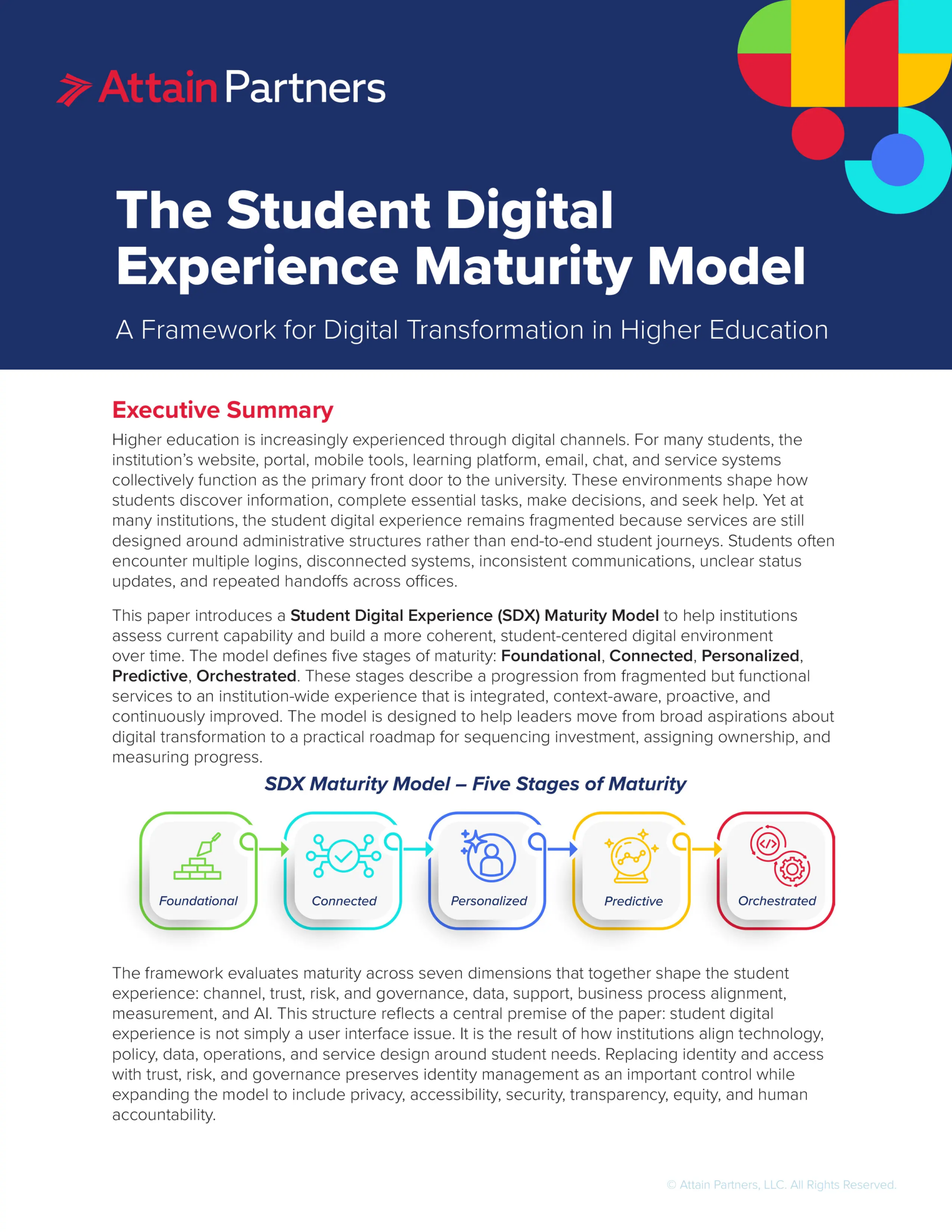
Where does your institution fall on the journey from fragmented digital interactions to connected, personalized, predictive, and orchestrated student experiences?
Download our Student Digital Experience Maturity Model whitepaper to assess your institution’s current maturity, understand the capabilities that support connected student experiences, and identify opportunities to improve digital services across the student journey.
Which investments should come first, and what will it take to sustain them? Attain Partners brings deep industry expertise to our work alongside higher education leaders to assess readiness, align stakeholders, and build practical roadmaps for data, AI, and student experience.
Connect with our team to discuss your institution’s priorities.

Maureen Goldman is Director of Marketing and Communications at Attain Partners. She leads the firm’s marketing strategy and execution across digital, content, events, and communications, with a focus on driving growth and elevating Attain Partners’ position as a trusted advisor to nonprofit, higher education, research, and healthcare organizations. Maureen brings deep expertise in translating complex ideas into compelling, results-driven marketing initiatives that resonate with executive audiences and support measurable business outcomes.

Keep Your Finger
on the Pulse!
Subscribe to our monthly email newsletter for expert content to solve your organization’s issues and advance your mission.
Keep Your Finger
on the Pulse!
Subscribe to our monthly email newsletter for expert content to solve your organization’s issues and advance your mission.